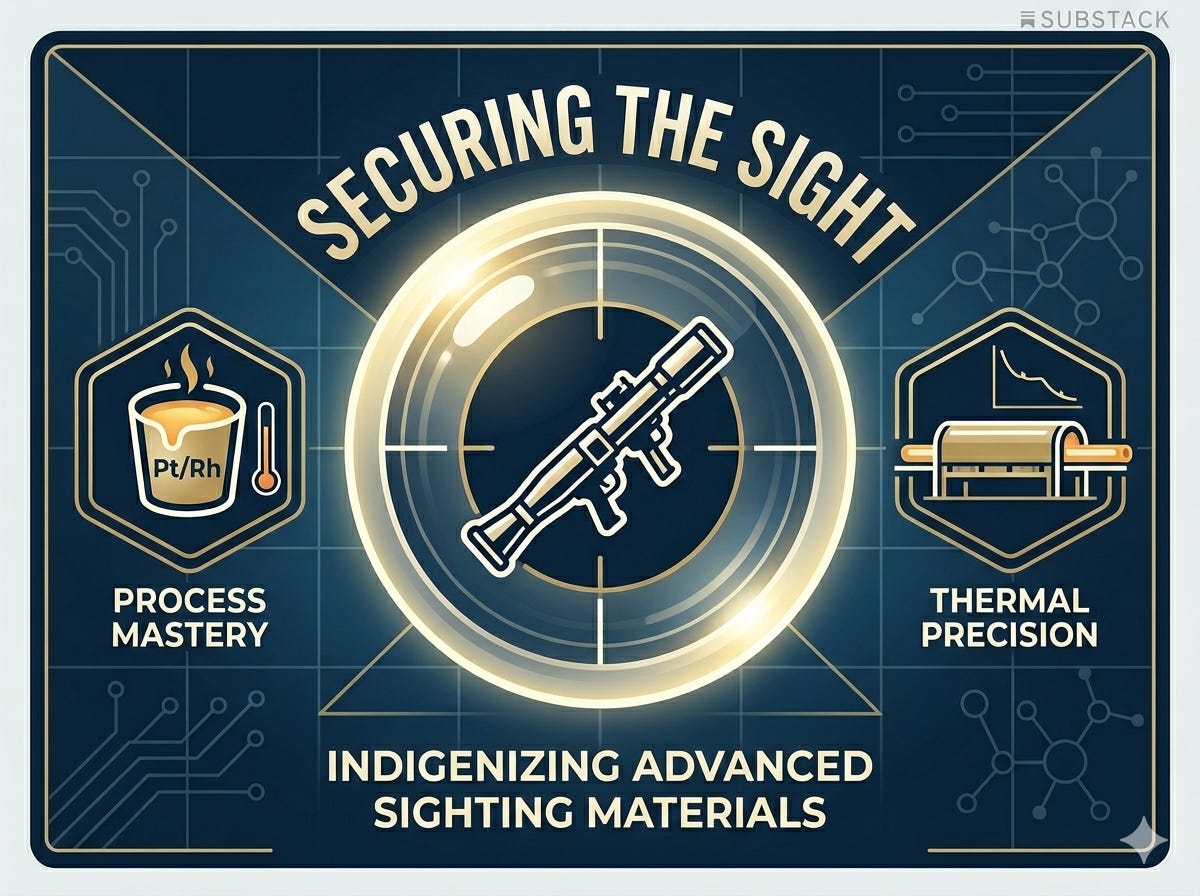
India’s defense landscape is undergoing a silent shift. In the Department of Defence Production’s 5th Positive Indigenisation List, one particular entry stands out: Transparent Glass (BSC-510644). This piece of glass is the “eye” of the 84mm Carl-Gustaf Rocket Launcher. By December 2027, this material must be made in India.
But why is a material as seemingly common as glass treated with the same strategic gravity as a missile guidance system?
1. Why Borosilicate Glasses are Critical Targets?
In the theater of modern warfare, the difference between a hit and a miss is measured in microns. Borosilicate Crown (BSC) glass is the bedrock of military optics. Unlike commercial glass, defense-grade BSC-510644 is engineered for extreme clarity, specific refractive indices, and thermal resilience.
These glasses are critical indigenization targets because they represent a single point of failure in the supply chain. If an adversary or a global crisis cuts off the supply of these optical “blanks,” the production of sighting systems for tanks, snipers, and rocket launchers grinds to a halt. Indigenizing this glass isn’t just about saving foreign exchange; it is about ensuring that the Indian soldier’s point of aim remains true, regardless of global geopolitics.
2. Legacy Expertise and How it Grew
For decades, the world of high-end optical glass was a closed club, dominated by a few giants: Schott (Germany), Hoya (Japan), and various state-run institutes in Russia.
Digression: Story of the 41 Glassmakers
The history of this expertise is steeped in espionage and strategic evacuations. In 1945, as World War II drew to a close, the U.S. military realized that the technical brilliance of the Schott factory in Jena was too valuable to be left behind. In a mission known as “The Odyssey of the 41 Glassmakers,” they evacuated the top scientists and their families to West Germany. This move ensured that the “Trade Secrets” of the melt—the exact stirring speeds and temperature curves—remained in the West. It proved that in this industry, the process is more valuable than the patent. You can see this more in material tech than in say software. (Another example is the jet engine blade crystals with long learning curves in the metallurgy process over decades.)
These companies developed their edge through a century of trial and error, moving from ceramic pots to platinum-lined crucibles, slowly mastering the “fluid dance” of molten silica.
3. Synthesis and Process Hurdles
If the chemistry is the recipe, the synthesis is the “hell’s kitchen” of engineering. Manufacturing BSC-510644 presents three brutal challenges:
Platinum Problem: At 1400 deg C, molten glass is a universal solvent—it “eats” ceramic containers. To maintain the “Six Nines” purity required for defense, manufacturers must use massive Platinum-Rhodium crucibles. This adds a staggering upfront CapEx and requires specialized induction heating.
Boron Volatilization: Boron gives the glass its unique properties, but it does evaporate at high heat. If the surface of the melt loses too much Boron, the refractive index shifts, ruining the entire batch. Engineers must use counter-rotating platinum impellers to constantly fold the surface back into the liquid.
Months-Long Cool Down: Precision annealing is the final hurdle. To prevent internal mechanical stress, a large block of glass might need to be cooled at a rate of just 1 deg C per day. One power failure or a slight dip in temperature, and the million-dollar melt shatters into worthless shards.
4. Who Can Invest in India?
With a CapEx requirement estimated in 100s of crores, this is a game for players with deep pockets and a long-term strategic vision.
For years, India’s CSIR-CGCRI in Kolkata functioned as the “R&D lab of the nation,” successfully melting these glasses on a pilot scale. However, the bridge from lab to factory remained unbuilt until recently. We are now seeing a shift where the government provides the “recipe,” and the private sector provides the “scale.”
Potential Investors:
Paras Defence & Space Technologies: Currently the most aggressive private player in defense optics, they have already begun securing international partnerships to bridge the “process gap.”
Borosil Limited: As the masters of commercial borosilicate in India, they possess the foundational chemical knowledge. A move into defense-grade melts would be a logical “value-up” for their specialty glass division.
Asahi India Glass (AIS): With their massive industrial footprint, they have the balance sheet to sustain the long “learning curve” associated with high-precision melts.
As the December 2027 deadline approaches, the race to master the melt is on. The companies that successfully cross this “platinum moat” will be securing the eyes of the Indian Armed Forces.